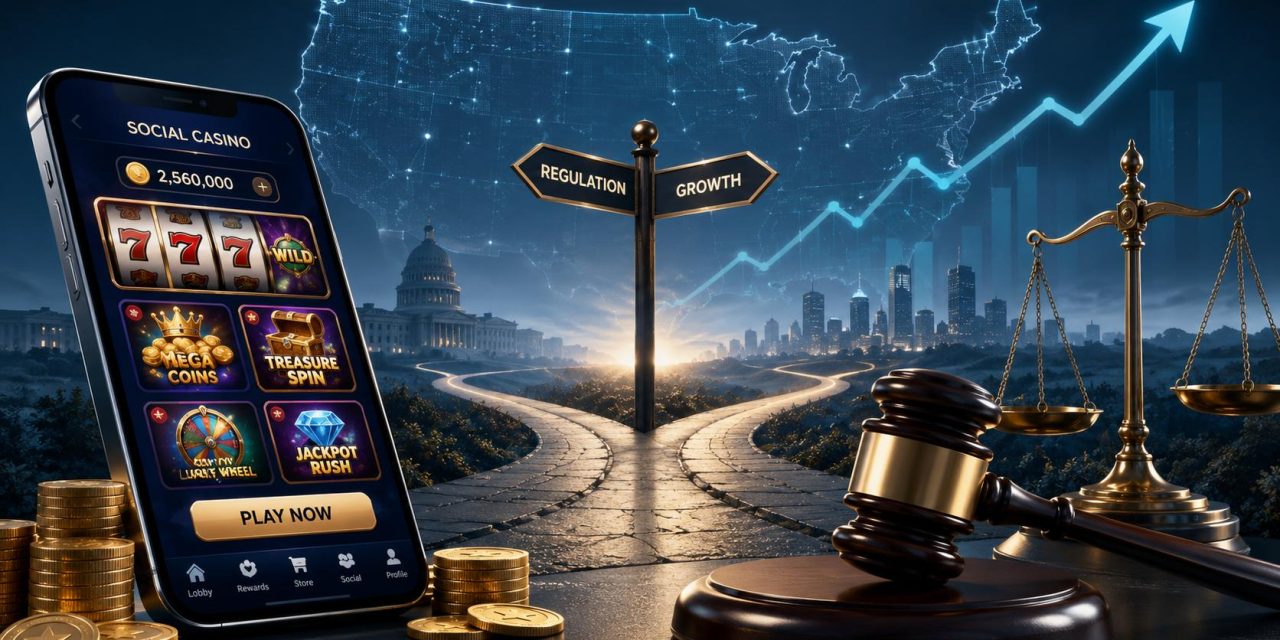
Sweepstakes casinos have developed from a relatively niche form of social gaming into one of the most closely watched segments of the US digital entertainment market.
Their growth has been driven by a simple proposition: casino-style games can be offered in states where regulated real-money iGaming remains unavailable. By combining free social play with promotional currencies that may be redeemed for prizes, operators have reached audiences far beyond the small number of states permitting licensed online casinos.
That expansion has also brought the sector to a decisive moment. Legislators, gaming regulators, tribal organizations and licensed operators are questioning whether the sweepstakes model remains a genuine promotional format or has evolved into an alternative form of online gambling.
The industry must now determine whether it can adapt to tighter standards or face a steadily shrinking addressable market.
Why the Model Grew So Quickly
The popularity of sweepstakes gaming is closely connected to the fragmented US regulatory landscape.
While sports betting has expanded across much of the country, real-money online casino gaming remains limited to a relatively small group of states. As explained in Casino International’s comparison of regulated online casino markets in the US and Europe, American iGaming policy is determined largely at state level rather than through a single national framework.
Sweepstakes operators found space within this fragmented system by structuring their platforms around promotional contest principles.
Most use two forms of virtual currency. One is intended purely for entertainment and cannot be redeemed for prizes. The second may be obtained through free-entry methods, promotional bonuses or as an addition to purchases of the entertainment currency. Subject to platform conditions, eligible winnings generated with the promotional currency can be redeemed for cash or other prizes.
This distinction is central to the sector’s legal position. Traditional gambling generally involves three elements: chance, consideration and a prize. Sweepstakes businesses argue that providing a free method of entry removes the consideration element.
For consumers unfamiliar with this structure, independent guides to sweeps casinos increasingly explain how the two-currency system, entry methods and prize redemptions work in practice.
The format has also benefited from advances in mobile technology, payment processing and casino content. Modern platforms can offer polished interfaces, extensive slot catalogues, live dealer-style experiences, loyalty programs and social features comparable to those found at conventional online casinos.
Entertainment or Unregulated Gambling?
The distinction between promotional gaming and gambling is becoming increasingly contested.
From the operator’s perspective, the absence of a mandatory purchase preserves the sweepstakes structure. Players can receive promotional currency through daily rewards, social media offers, mailed requests and other free entry routes.
Critics focus less on whether a free route technically exists and more on how the product is designed, marketed and used.
The American Gaming Association has argued that some platforms closely resemble online casinos while operating outside the licensing, taxation and consumer-protection requirements applied to regulated businesses. Its research also found that a substantial majority of users perceive sweepstakes casino participation as gambling rather than purely social entertainment.
The association’s research into sweepstakes casino players reported that 90% of surveyed users considered the activity to be gambling, while 69% described the platforms as places to wager real money.
These findings have strengthened calls for lawmakers to assess commercial reality rather than relying only on the technical mechanics of a dual-currency system.
At the same time, the sweepstakes industry argues that responsible operators provide clear rules, free entry options, age restrictions, identity checks and voluntary player controls. It also maintains that social promotional gaming should not automatically be treated in the same way as a licensed real-money casino.
The disagreement is therefore no longer simply about terminology. It concerns the level of oversight appropriate for products that look and feel increasingly similar to conventional iGaming.
State Action Is Reshaping the Market
The regulatory environment changed considerably during 2025 and has continued to evolve.
California, Connecticut, Montana, New Jersey and New York passed measures explicitly prohibiting certain sweepstakes gaming platforms. Other jurisdictions have relied on existing gambling laws, cease-and-desist letters or regulatory interpretations instead of introducing dedicated legislation.
New York demonstrated how enforcement can rapidly alter a market. In June 2025, the state Attorney General announced that 26 online sweepstakes casino platforms would cease relevant operations following action taken alongside the New York State Gaming Commission.
For operators, the emerging state-by-state system creates considerable compliance complexity. A platform may be available in one jurisdiction, restricted in another and subject to an unresolved legal interpretation elsewhere.
Payment providers, game studios, affiliates and advertising platforms may also be affected. Some legislative proposals have been drafted broadly enough to cover companies that promote, supply or otherwise support prohibited sweepstakes operations.
This raises the cost of market entry and makes continuous legal monitoring essential.
It also reinforces the wider contrast between social promotional platforms and the licensed online casino experience available to US players. Regulated operators must meet formal requirements covering game testing, customer funds, anti-money laundering controls, responsible gaming and reporting. Sweepstakes businesses may implement similar measures voluntarily, but the precise standards and enforcement mechanisms vary.
Regulation Could Take Several Forms
An outright ban is not the only possible regulatory outcome.
States could create clearer definitions separating traditional consumer promotions from platforms offering continuous casino-style play. They could also introduce registration, taxation, age-verification and disclosure requirements without placing sweepstakes operators under the full structure applied to real-money casinos.
Another possibility is a dedicated licensing category for promotional gaming. Such a framework might establish minimum standards for free entry, prize redemption, marketing, game fairness, player verification and responsible gaming controls.
This could provide greater certainty for reputable businesses while making it easier for authorities to identify operators that fail to meet acceptable standards.
However, a separate regime would still need to address difficult questions. Regulators would have to determine when optional purchases become the practical center of the product, how prominently free entry methods must be displayed and whether redeemable virtual currencies should be treated as items of value.
The outcome will differ between states. Jurisdictions with established commercial or tribal gaming interests may favor strict restrictions, while states without regulated iGaming could see value in a controlled alternative.
The Next Phase of Social Gaming
Sweepstakes casinos are unlikely to disappear entirely. The broader demand for accessible, mobile-first casino entertainment remains strong, particularly in states without licensed online casino markets.
The sector’s future, however, may look different from its recent period of rapid expansion.
Operators will probably need to invest more heavily in geolocation, identity verification, responsible gaming systems and transparent marketing. Free-entry routes may require greater visibility, while promotional claims and currency descriptions will face closer scrutiny.
Some companies may shift towards purely social gaming without cash-equivalent prizes. Others may pursue partnerships or licenses in regulated markets. Larger operators with sufficient compliance resources could remain active across a reduced number of states, while smaller brands may find the increasingly fragmented environment difficult to navigate.
The central question is no longer whether sweepstakes casinos can attract players. Their commercial appeal has already been demonstrated.
The question is whether the industry can establish a model that legislators, regulators and consumers regard as sufficiently transparent and accountable. How operators respond during this period will determine whether sweepstakes gaming develops into a recognized category of regulated digital entertainment or becomes progressively restricted as an unlicensed substitute for online gambling.