
The United States of America has played an integral part in Formula 1 (F1) Grand Prix racing since its very first race in Sebring (1959). However, the move to the Indianapolis Motor Speedway in 2000 was arguably the sport’s first big step in trying to break the USA.
Four US circuits have had the honour of hosting a F1 Grand Prix event since the turn of the millennium: Indianapolis Motor Speedway, Circuit of the Americas, Miami International Autodrome and the Las Vegas Strip.
Over the past decade the popularity of Formula 1 has exploded. According to Motorsport.com there are currently around 52 million F1 fans in America, which is a 10% increase from 2024. The introduction of Netflix’s Drive To Survive has played a crucial role in bringing a wider and younger audience into the sport. As of the 2025 F1 season, three states host a race; Florida, Texas and Nevada – with Las Vegas welcoming the F1 world this weekend.
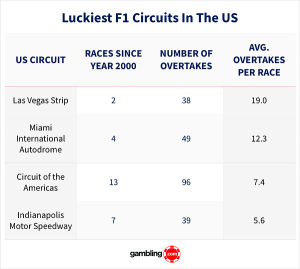
Las Vegas is considered the home of luck, gambling and casinos – so Gambling.com decided to find out which of the US F1 circuits since 2000 is the luckiest. To find this out, they divided the number of overtakes at each circuit by how many times it had hosted a race – which calculated the average number of overtakes per race at each circuit. Finally, the circuits were ranked from most overtakes (luckiest) to least (unluckiest).
Las Vegas Strip: Luckiest US F1 Circuit
Although Las Vegas has only been recently introduced to the F1 calendar, it seems to have been a hit with drivers so far. Over the last two Las Vegas Grand Prix’s there has been an average of 19 overtakes per race – making it the Luckiest US F1 Circuit.
The Las Vegas Strip weaves its way past some of the most iconic casinos in the world. The Cosmopolitan (turn 14) has seen the most action by quite a distance, with an average of 9.5 overtakes per race. The corners that pass the Wynn Las Vegas (turn 12) and the Bellagio (turn 17) are well behind, with 2.5 and 1 average overtakes per race, respectively.
The Vegas layout mixes high-speed straights with tight corners, which promotes aggressive overtaking. The 6.201 km (3.853 mi) 17-turn temporary street circuit has been interwoven into the city’s skyline and hotspots – giving drivers and fans an exciting spectacle.
Luck Lives on the Strip – Not the Speedway
At the other end of the luckiest scale, the Indianapolis Motor Speedway is considered the least lucky/unluckiest F1 circuit in the US. Although the track is known for its extremely high speeds, it has limited overtaking opportunities and no DRS (drag reduction system), so from 2000 to 2007 the circuit only averaged 5.6 overtakes per race.
The second luckiest F1 circuit in the U.S. is the Miami International Autodrome, located at the Hard Rock Stadium. The 5.41 km circuit incorporates 3 DRS zones and has seen top speeds of 320km/h. This combination of high speed and heavy braking means overtaking is very popular – since its first race in 2022 it has seen an average of 12.3 overtakes per race.
The Circuit of the Americas in Texas has become popular with fans and was a major force in putting F1 back on the US map. The circuit saw the most overtakes (96), however due to its longevity in hosting F1 races (2012-2025), it has only averaged 7.4 overtakes per race – making it the third luckiest.